
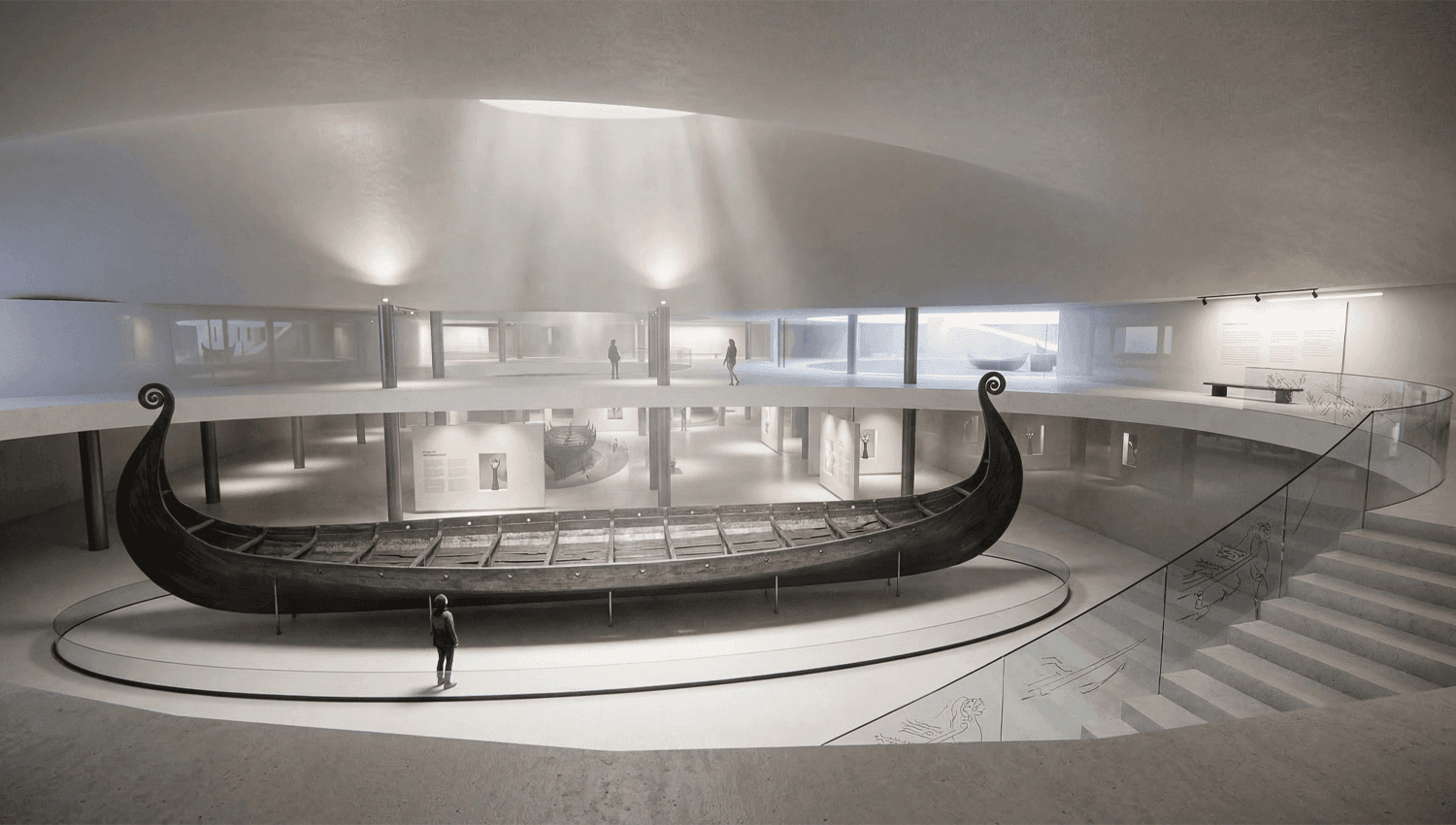
Picture this: you step into a cool, dim hall and a 1,200-year-old oak hull rises above you like a dark wave. That goosebump moment is exactly what Oslo’s reborn Viking museum is designed to deliver — only now bigger, better protected, and built for storytelling that goes far deeper than most visitors expect.
The old Viking Ship Museum on Bygdøy closed in September 2021 to make way for something extraordinary. The new Museum of the Viking Age is being constructed as a major extension on the Bygdøy peninsula, designed by AART Architects and commissioned by Norway’s Ministry of Education. When it reopens in 2027, it will house the three famous Viking ships — the Oseberg, Gokstad, and Tune — alongside more than 5,500 artefacts, making it the largest Viking Age museum in the world.
The original museum was built for just 40,000 visitors a year. The new facility will serve millions, with state-of-the-art climate control, public-facing conservation labs, and exhibition spaces built to protect 1,200-year-old wood for centuries to come.
As local guides who walk Oslo every single day, we know the stories behind these ships that most visitors never fully hear. This is your insider guide — the history, the secrets, and everything you need to plan your visit.
Let’s dig in.
The complex expands to roughly 13,000 m² — approximately three times the size of the old museum — with around 5,000 m² of exhibition space. The original 1926 Arneberg building is being retained and integrated with the new AART-designed wing, refurbished as entrance, education, and shop spaces.
Beyond the size, the shift is about preservation. Expert reviews had flagged vibration, dust, and outdated supports in the old venue as active risks to the ships. The new facility features purpose-built floors, vibration control, and modern climate systems — addressing micro-cracking risks identified in the old setup. This is why the museum had to shut for years: preservation on a century horizon, not just prettier displays.
The complex will also include research labs with public viewing areas, an auditorium, café, and a fully re-curated collection of 5,500+ Viking Age objects.
Can’t wait until 2027? You can already see remarkable Viking Age artefacts at the Historical Museum (Historisk Museum, Frederiks gate 2) in central Oslo — currently open to the public, featuring the VÍKINGR exhibition. Also worth visiting while you wait: the Viking Planet near City Hall (Norway’s first digital Viking museum, with 270° cinema and VR reconstructions), and the other Bygdøy museums: Fram Museum, Kon-Tiki Museum, and the Norwegian Maritime Museum.
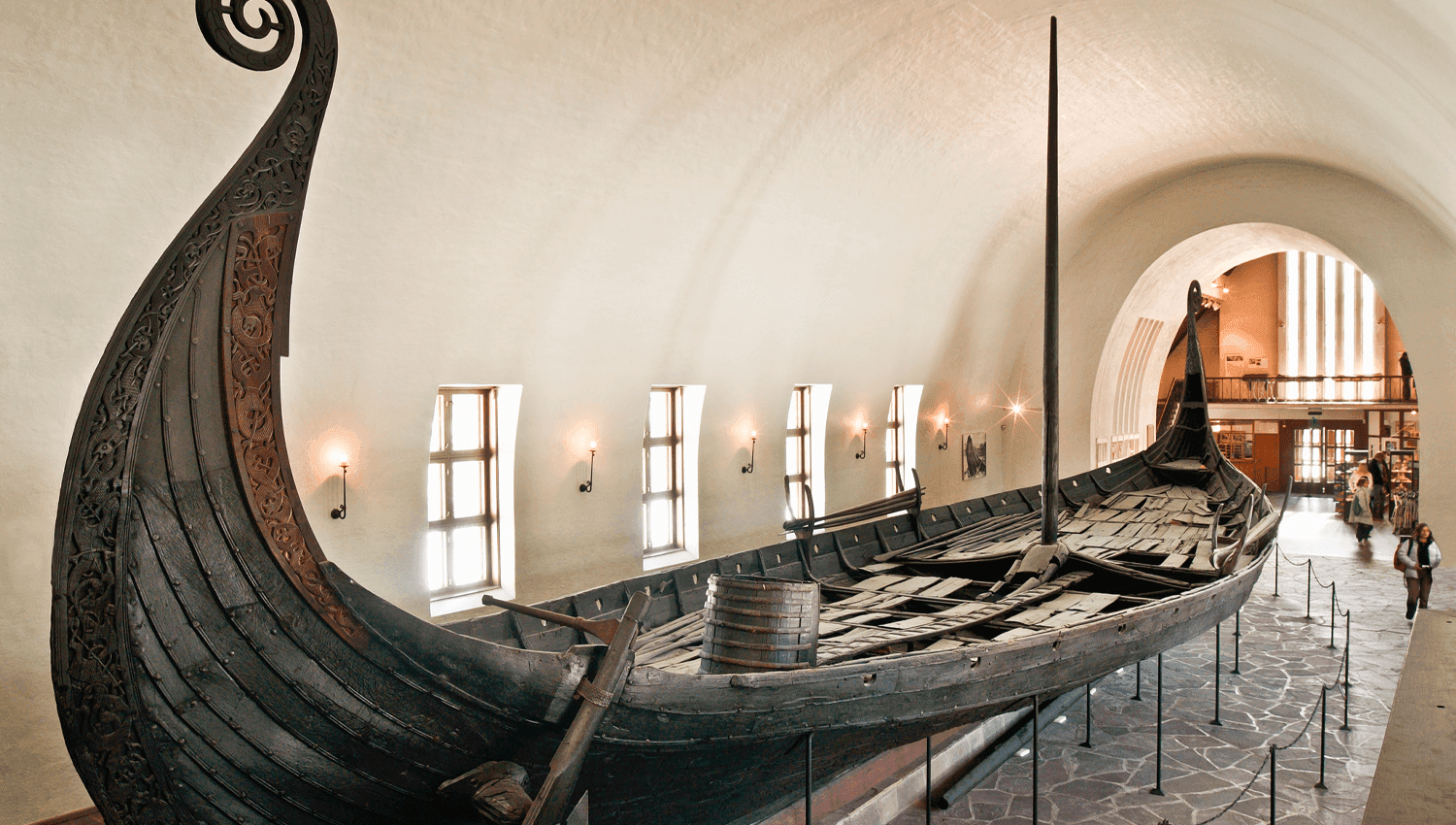
The crown jewel of the museum is the Oseberg ship — a spectacular 22-metre oak vessel built around 820 CE, lavishly carved with ornament and fitted with 15 oar holes per side. But what most visitors don’t realise is that this ship was the burial chamber of two women whose identities remain one of Norway’s greatest historical mysteries.
When archaeologist Gabriel Gustafson excavated the Oseberg mound in 1904, he expected to find a male chieftain. Instead, he found two female skeletons surrounded by extraordinary grave goods: four elaborately decorated sleighs, the only complete Viking Age cart ever discovered, silk textiles, weaving tools, beds with down quilts, and the skeletal remains of 15 horses, 6 dogs, and 2 cows.
One woman was around 80 years old at death — an age so advanced she would have seemed almost mythical to her contemporaries, when average life expectancy hovered around 30. The other was roughly 50. Both had eaten primarily land-based food — meat and grain rather than fish — which archaeologists interpret as a marker of the highest social elite.
For decades, historians speculated the elder was Queen Åsa, grandmother of Harald Fairhair. But the evidence is thin: Queen Åsa appears only briefly in 13th-century sagas written centuries after the burial. Recent isotope studies show both women lived in the Agder region — consistent with Queen Åsa’s territory — but still far from proof.
A rune inscription carved on a bucket in the burial reads simply: “Sigrid owns me.” A wooden stick found nearby reads: “Man knows little.” Over a thousand years later, that still rings true.
Beyond the Queen Åsa theory, a compelling alternative has emerged: one of the two women may have been a völva — a female seer who held enormous spiritual power in Viking society.
Several objects in the burial suggest ritual use rather than everyday function: five intricately carved animal head posts (whose purpose remains unknown), a rattle, a riding crop, and a cart panel carved with imagery of cats — a direct reference to Freya, the Norse goddess of magic, love, and death, whose chariot was pulled by cats.
Viking society had a specific, respected role for women who practised seiðr, a form of Norse magic. A völva would travel between communities performing prophecy and ritual. Burying one with a ship, horses, and a full household’s worth of goods would make perfect sense if she was considered a bridge between the living world and the realm of the gods.
The Oseberg grave may not be the burial of a queen at all — but of Norway’s most powerful spiritual figure.
Among the Oseberg grave goods sits an object that genuinely surprises archaeologists: a decorated brass bucket whose handle is shaped like two figures sitting cross-legged in what looks unmistakably like a lotus position. Scholars have nicknamed it the “Buddha bucket” (Buddha-bøtte in Norwegian).
The enamel decoration closely resembles the Insular art style found in Irish Gospel books like the Book of Durrow. The most widely accepted theory? This bucket was Irish loot, brought back by Viking raiders from monasteries on the Irish coast — with no idea they were carrying something that would puzzle archaeologists for generations.
The Oseberg burial is, in fact, one of the finest windows we have into Viking contact with the wider world: silk from the East, objects from Ireland, and a burial rite sophisticated enough to rival anything in European medieval history.
While Oseberg gets most of the attention, the Gokstad ship — dated to around 890 CE and roughly 23 metres long — holds a darker story.
When the burial mound at Kongshaugen was excavated in 1880, archaeologists found the skeleton of a powerfully built man in his forties, nearly 180 cm tall — significantly taller than the average Viking of the period. Forensic re-examination in 2007 by Professor Per Holck at the University of Oslo revealed something chilling: this man died violently.
Five or six distinct cut marks from an axe, sword, and knife were found on his leg bones, with no signs of healing — meaning the injuries were inflicted at or near the time of death. The most likely cause was a stab wound to the right inner thigh, severing the femoral artery.
For over a century, historians assumed he was King Olaf Geirstad-Alf of the Yngling dynasty. But dendrochronological dating of the ship places the burial around 901 CE — roughly 50 years after Olaf would have died. The man in the mound is not who we thought he was.
His burial had also been plundered in antiquity. What survived — 64 painted shields along the ship’s railing, 12 horses, 8 dogs, and remarkably two peacocks — paints a picture of someone with extraordinary access to rare and exotic animals. Peacocks in 9th-century Norway were not common. Whoever he was, he had serious reach.
All three ships arrived safely in the new museum halls — Gokstad reaching its final position in October 2025 — after a once-in-a-century engineering effort using millimetre-tolerance rigs and overhead cranes monitored for load shifts throughout each move.
The third and least celebrated ship, the Tune ship, is often overlooked — but carries a fascinating secret. Excavated in 1867 (the first of the three to be unearthed), it was long assumed to be a purpose-built burial ship. Closer examination of wear patterns on the keel told a different story: this ship had actually been used at sea.
Researchers now believe it was a fast coastal courier vessel — built for 12 oarsmen, designed for speed, with unusually strong rigging for its size. It was likely used to carry messages, goods, or important passengers along the Norwegian coastline before someone decided this agile ship was worthy enough to carry a person of importance into the afterlife.
The Tune ship also owes its survival to a stroke of luck: a 19th-century officer halted a farmer’s digging and alerted heritage authorities, arguably saving the find. In February 2026, it became the last of the three ships moved into the new museum.
Here’s the preservation miracle that almost nobody talks about: the reason these ships survived at all — in conditions almost unparalleled in world archaeology — is blue clay.
When the burial mounds were constructed, the ships were sealed under turf over soft, waterlogged clay subsoil, creating an anaerobic environment essentially devoid of oxygen that dramatically slowed decomposition of all organic material. Wood, textiles, leather, and even food survived for over a millennium.
The Oseberg mound alone was 44 metres in diameter. Its weight pressed the ship deep into the clay, creating a near-perfect seal. It is this blue clay — not luck — that gave the world the Oseberg tapestry fragments (some of the only surviving Viking Age textiles), the wooden cart, and those hauntingly beautiful carved animal head posts.
Year-round: Ruter Bus 30 to Bygdøy (stop: Vikingskipene) — included in regular Ruter tickets and the reliable off-season choice. You’ll reach the museum in under 30 minutes from the city centre.
April–October: Ferries from City Hall Pier 3 to Bygdøy every ~20 minutes — ideal for chaining multiple museums in one day on a full Bygdøy circuit.
Pro tip: Combine the Museum of the Viking Age with the Fram Museum, Kon-Tiki Museum, and the Norwegian Maritime Museum — each a short walk from the ferry, making a full peninsula day effortless for families and groups.
| Where | What | Status |
|---|---|---|
|
Historical Museum, Frederiks gate 2 |
VÍKINGR exhibition — authentic Viking Age artefacts |
Open now |
|
Viking Planet, near City Hall |
270° cinema, VR reconstructions |
Open now |
|
Fram / Kon-Tiki / Maritime Museums |
Bygdøy maritime history |
Open now |
|
Raknehaugen (30 min northeast of Oslo) |
Largest burial mound in Northern Europe |
Open now |
|
Museum of the Viking Age, Bygdøy |
The three ships + 5,500 artefacts |
Opens 2027 |
As walking tour guides who work Oslo’s streets every day, we see how often travellers plan their entire visit around the Viking ships. Smart move — just time it right.
Until 2027, the Historical Museum delivers a rich Viking fix in the city centre. When the Museum of the Viking Age reopens, expect a world-class, conservation-first experience that is genuinely worthy of the hype.
And if you want to hear more stories like these in person — join our free tip-based Oslo walking tour, where we bring Norwegian Viking history to life on the streets where it all began.