

When people picture Oslo they think of Viking ships, fjord cruises, and forest stretching past the city limits. Fewer realise the city is also home to one of the world’s most prestigious awards.
The Nobel Peace Center sits on the waterfront between City Hall and Aker Brygge, and it does something unusual for a museum: it is almost entirely about people. Whether you come for the history, the current affairs angle, or simply because it’s one of the more meaningful stops in the city, it earns its place on an itinerary.
Where |
Brynjulf Bulls plass 1, on the waterfront between City Hall and Aker Brygge |
Opening hours |
Closed Mondays · Tue, Thu–Sun 11:00–17:00 · Wednesday 11:00–20:00 |
Admission |
180 NOK adult · 100 NOK student · free for ages 0–17 · free with Oslo Pass |
Right now |
Half price until 12 December 2026 — see the notice below |
Time needed |
90 minutes normally; around an hour during the current renovation |
Building |
The former West Railway Station (Vestbanen), 19th century. The centre opened in 2005 |
This is the museum and visitor centre dedicated to the Nobel Peace Prize and its laureates. It opened in 2005 in the former West Railway Station — Vestbanen — a nineteenth-century building that most visitors assume was purpose-built.
Rather than filling cases with artefacts, the place works through stories: photography, film, interactive installations, multimedia and a steady rotation of temporary exhibitions. The result feels modern and surprisingly personal.

This is the question visitors ask most. The prizes for Physics, Chemistry, Literature, Medicine and Economics are awarded in Stockholm. The Peace Prize is awarded in Oslo, and that split comes straight from
Alfred Nobel’s will.
The laureate is chosen by the Norwegian Nobel Committee and receives the award in Oslo every year on 10 December, the anniversary of Nobel’s death.
Plenty of travellers walk through Oslo City Hall without realising they’re standing in the room where it happens. The ceremony has been held there since 1990 — the laureate receives the diploma and medal and delivers the Nobel Lecture, with the royal family, government, diplomats and invited guests in attendance.
It hasn’t always been there. The venue has moved four times:
| Years | Where the ceremony was held |
|---|---|
1901–1904 |
The Norwegian Parliament (Stortinget) |
1905–1946 |
The Norwegian Nobel Institute |
1947–1989 |
The University of Oslo Aula, under Munch’s murals |
1990–today |
Oslo City Hall — the Aula had become too small |
The exhibitions are about people rather than objects. You meet laureates through photographs, interviews, film, personal accounts and interactive displays covering peace work, democracy, human rights, diplomacy and humanitarian work.
Visitors routinely stay longer than planned, because a lot of it invites reflection rather than simply presenting information. It reads less like history and more like hearing from the people involved.

For many people this is the high point. It introduces laureates from different countries, backgrounds and generations — some world-famous political figures, others organisations, activists, journalists and human rights defenders whose names may mean nothing to you before you walk in.
What comes across quickly is that there’s no single route to changing anything. One section is about diplomacy, the next about freedom of expression, the next about someone who spent a life working against poverty, conflict or discrimination. The range is the point.
The building is older than the museum. It’s Oslo’s former West Railway Station, from the nineteenth century. The centre itself opened in 2005.
No two visits are the same. Temporary exhibitions on contemporary issues rotate regularly, so returning visitors usually find something they haven’t seen.
This is not where the winner is chosen. The Norwegian Nobel Committee selects the laureate. The centre handles exhibitions, education and public engagement — a distinction a surprising number of visitors get wrong.
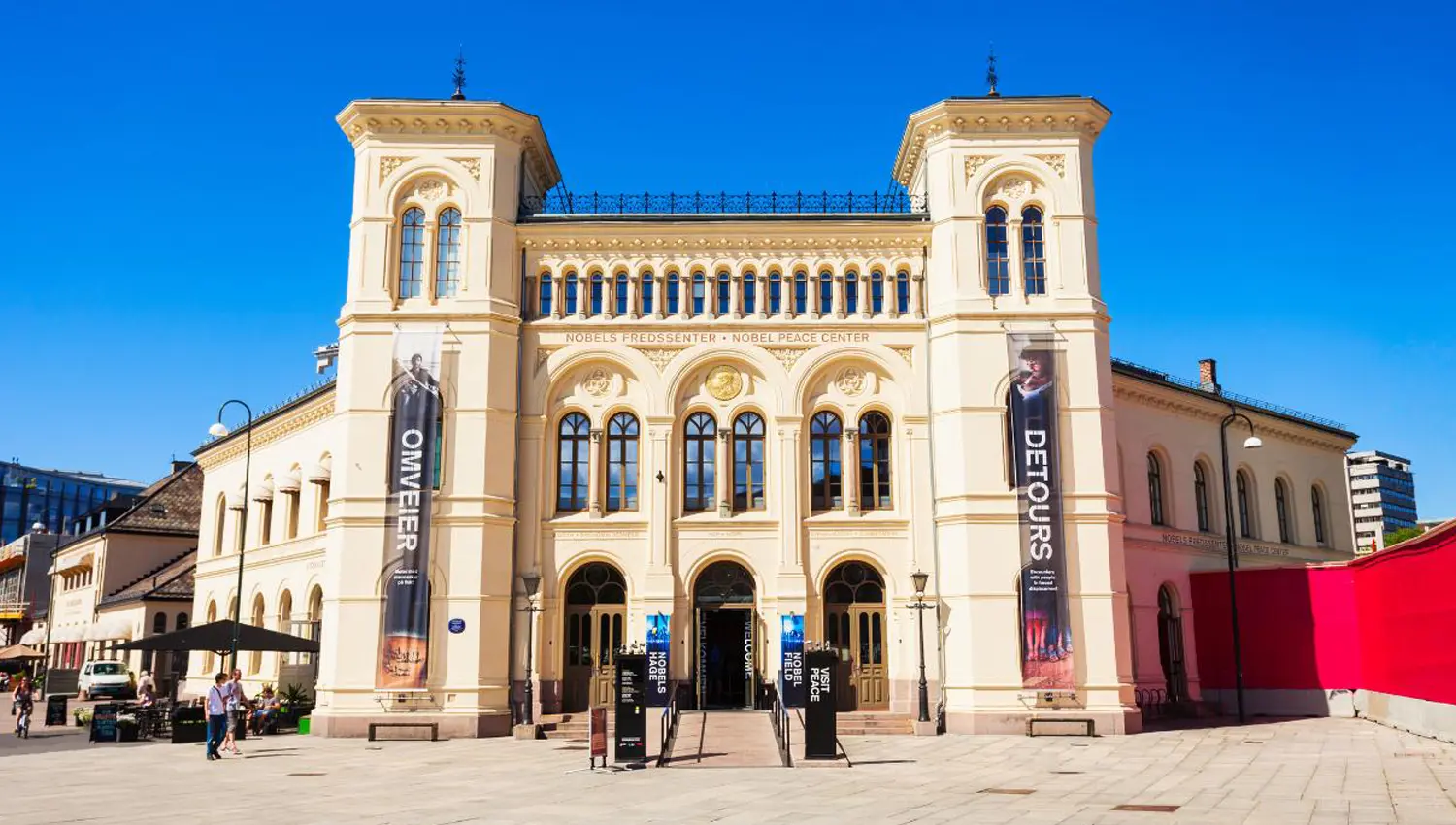
The location does a lot of work. From the door you’re a short walk from Oslo City Hall, Aker Brygge, the National Museum, Akershus Fortress, the waterfront promenade and several ferry terminals.
It slots naturally into a day on foot around the harbour, and it’s one of the better things to do in Oslo when the weather turns — which, to be honest, is how a lot of locals end up recommending it.
Mornings are quieter. And Wednesday is the long day — open until 20:00, which is the easiest evening slot in central Oslo.
Check what’s on before you come. The temporary exhibitions change, and right now part of the building is closed for renovation.
Combine it with City Hall. Seeing the museum and then the room where the ceremony is actually held makes both better.
It’s a strong rainy-day option. Entirely indoors, centrally located, and a short walk from several other covered attractions.
Allow 90 minutes normally, or around an hour while the second-floor exhibitions are closed.
Yes, particularly if you want something other than the standard sightseeing round. It handles complicated global subjects without becoming heavy going, and you don’t need a background in politics or international relations to follow any of it.
What you leave with is a clearer sense of the people and organisations who have tried to improve things, usually under conditions most of us would find impossible. It isn’t Oslo’s biggest museum. It may be its most thought-provoking.
The Peace Prize makes a lot more sense once you know why a small country ended up holding it, how Oslo grew around this harbour, and what else happened in these buildings. That’s much of what we cover on our free walking tour — 90 minutes, daily, meeting by the Tiger statue outside Oslo Central Station, a few minutes’ walk from the waterfront.
Tips-based: free to join, and you decide at the end what it was worth.